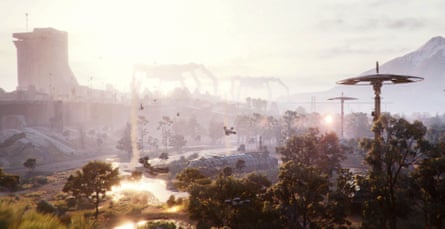
The video game Arc Raiders is set in a lethal imagining of an apocalyptic future for humanity. Survivors have been forced to live deep underground in colonies while mysterious, murderous AI machines patrol the surface. Only the desolate ruins of former cities survive, and reckless human “raiders” take trips topside to conduct dangerous scavenging missions.
For all the menace of these armed robots, called Arcs, the deadly droids are not the biggest threat in this hugely popular game, which was released late last year and has sold more than 14m copies. Raiders operate with the constant anxiety that another person will shoot them on sight and steal their loot. Mercilessness is rewarded in this kind of competitive, high-stakes world.
So it has come as a jolt to the game’s developers at Embark Studios in Sweden that many players are not shooting at each other at all. “It caught us a little bit by surprise,” says executive producer Aleksander Grøndal, who has found that many people play “a more peaceful version of the game than we anticipated”. He is quick to add: “Pleasantly surprised, just to be clear.”
Unintentionally, the game has become a sort of social and psychological experiment, raising questions about game design – and the human condition – that have intrigued social scientists, psychologists and criminologists. Roughly one in five players have never knocked out another raider, and half have knocked out fewer than 10.
In most shooters, from Fortnite to Counter-Strike, killing other players is the point – and the way to earn points. (Many of the development team at Embark are experienced with other fast-paced shooter games, including the massive Battlefield and Call of Duty franchises.) And Arc Raiders is part of a growing subgenre of shooting games that are notoriously cutthroat: the extraction shooter, where players compete not just with each other but with the world itself, working against the clock to get out of each round alive and with their scavenged treasure intact. Sessions are intense, with high risk v reward gameplay in which death often comes right at the end of a hard effort gathering loot, as you are ambushed by another player seeking to steal swag. So why aren’t Arc Raiders’ players behaving as mercilessly as the environment calls for?
Grøndal says the team knew there was room for some cooperation. “We always wanted [that] to be the case, but it was a little bit surprising to see how many people latched on to that aspect of the game … It kind of blew the whole extraction shooter open, because it doesn’t always have to be about conflict with other players.”
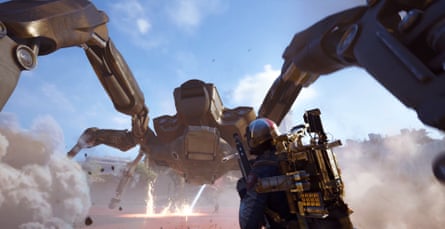
What are people doing instead of shooting each other in this ravaged world? Many are teaming up to take down the robot monsters, which range from flying drones to spherical balls that blast fire. Others try to sneak quietly around them to scavenge rare resources. Grøndal says players also hold spontaneous rave parties, where people play music through their microphones.
But often, players are just talking. A YouTube video called The Humans of Arc Raiders, inspired by the photographer who interviews strangers in New York City, includes conversations with randomly encountered players. They talk about family struggles, work lives, depression, autism and, in one case, a lung collapse. In one conversation, a heavily armed player in green armour named Poopy candidly asks another raider: “What’s it like having kids, dude?”
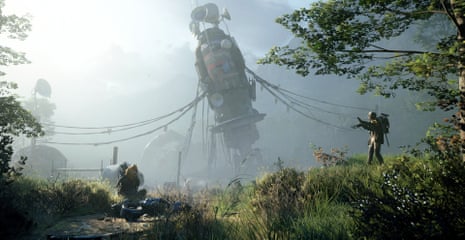
When I first jumped into Arc Raiders, I found a dichotomy on the topside, where birds sing and plants thrive among the carcasses of downed machines. The more I wandered around this 1970s-style retro-future setting, the more I bumped into other humans, many of whom offered help, such as medical supplies. Mostly we snuck around and battled robots together. It was tense at times, sometimes scary, but often relaxing.
In one session, I encountered another player with a British accent who was also new to the game. “Have you been killed by another person yet?” he asked me, as we explored a burst concrete dam complex. “Because every person I’ve met has been friendly,” he added. “No one kills each other.”
I must have gotten used to the lack of human-on-human violence because the first time I was eliminated by another person, I felt quite offended. Clearly, I had been lured into a warm feeling of human camaraderie, and it was hard not to be upset. It was as if my attacker had broken an unwritten rule that we were all supposed to help each other out.
That was, in fact, the aim of the original game Embark had hoped to create – a shared fight against the machines where human players physically cannot fight each other. But late in the development process, they thought it would get boring, so changed it to add in unpredictable humans and the added tension that brings.
Interestingly, there is a lot of spoken communication in Arc Raiders, with players using their microphones much more than in other games. In Arc Raiders, a player can hear any other people in their proximity, allowing them to shout out “I’m friendly!” or “Peaceful! Peaceful!”. More than 95% of players use this proximity chat feature, says Grøndal.
Many players do still shoot on sight, but they form a minority. Embark told the Guardian that about 30% of players are mostly interested in the cooperative aspects of the game; another 30% focus on the player-versus-player action; and the remaining 40% enjoy a mix of both. Those playing solo are generally more friendly, while those who group up into squads of three are more interested in firefights.
Sean Hensley, a graphic artist from Tennessee who makes YouTube videos about mental health and video games, has taken an interest in the game and believes players value “connection over competition”. “What players are getting from these friendly interactions is more rewarding than any game loot system or victory screen,” he said in a recent video.
The strongest catalyst for cooperation, however, might be a common threat. When Embark introduced a massive walking mechanical enemy called the Matriarch, Grøndal expected rival squads to be sneaky, waiting for others to expend their ammunition before attacking them to steal the loot. Instead, players used proximity chat to team up. “In an instant – like literally in less than 30 seconds – everyone on that server stopped shooting each other and faced the bigger challenge together,” he said. “And I hadn’t really anticipated the fact that every single one would cooperate that easily in a 30-second timeframe.”
This type of unexpected player behaviour can be problematic for developers, as they tweak an enemy’s difficulty depending on how they anticipate people will play. Easily downing a massive robot is less fun, and when everyone cooperates, it only takes a few minutes. “If it’s so easy for people to stop turning on each other,” says Grøndal, “we need to up the challenge.”
Whether players want human connection – or are making a cold, calculated decision that it is more profitable for all to cooperate – is a question for scientists, not video game developers, says Grøndal. He was recently contacted by a criminologist who he says was “really intrigued by how players are interacting with each other”.
Embark CEO Patrick Söderlund has previously said he was tapped on the shoulder by a neurology professor friend interested in the lessons they could learn from Arc Raiders about human behaviour. But has his own theories, rooted in the modern epidemic of isolation and loneliness. “I think that people are seeking connections with other players and maybe this is not so easy to do out in the real world any more because people are stuck on their phone,” he says. “Maybe we have kind of accidentally created a place for people to connect.” Because the virtual interactions are temporary, Grøndal feels the game functions “as a place to connect with other people and maybe open up without fear or repercussions or judgment”.
That tallies with my own experience in Arc Raiders, where I met plenty of people, but usually only for a few minutes, before they or I disappeared into the wilderness.
Arc Raiders is certainly not what it first seems to be. While it looks like a bleak future where humanity is struggling, there is hope here. “Yes, the Arcs have captured the surface and they’re the dominant. But if you look around you, nature has come back from an ecological collapse,” Grøndal says. “The animals are back and the world is thriving. We want to instil hope in the player.”